
AI first entered software development through code completion and generation tools. Developers can now write code, create tests and investigate problems faster with the help of AI.
But software development is not only about writing code.
Ideas must be clarified, requirements understood, technical decisions made, work planned, changes reviewed, software released and production systems maintained. When coding becomes faster, problems in these surrounding stages do not disappear. They often become more visible.
An AI-native software development lifecycle, or AI-native SDLC, treats AI not as an additional tool placed on top of an existing process, but as a new participant across the entire software lifecycle.
When a developer uses an AI assistant to write code, that is AI-assisted development. It can create valuable individual productivity gains while leaving the wider operating model unchanged.
If requirements remain unclear, decisions disappear across different tools, code is disconnected from business intent or reviews become a bottleneck, producing code faster will not solve the underlying problem.
An AI-native SDLC asks broader questions:
The real transformation is therefore not simply giving developers a new tool. It is redesigning the software development system so that people and AI agents can work together.
In this model, people set direction, exercise judgment and remain accountable for quality. AI agents help gather context, prepare drafts, carry out repeatable work and complete clearly scoped tasks.
Consider the development of a new product feature:
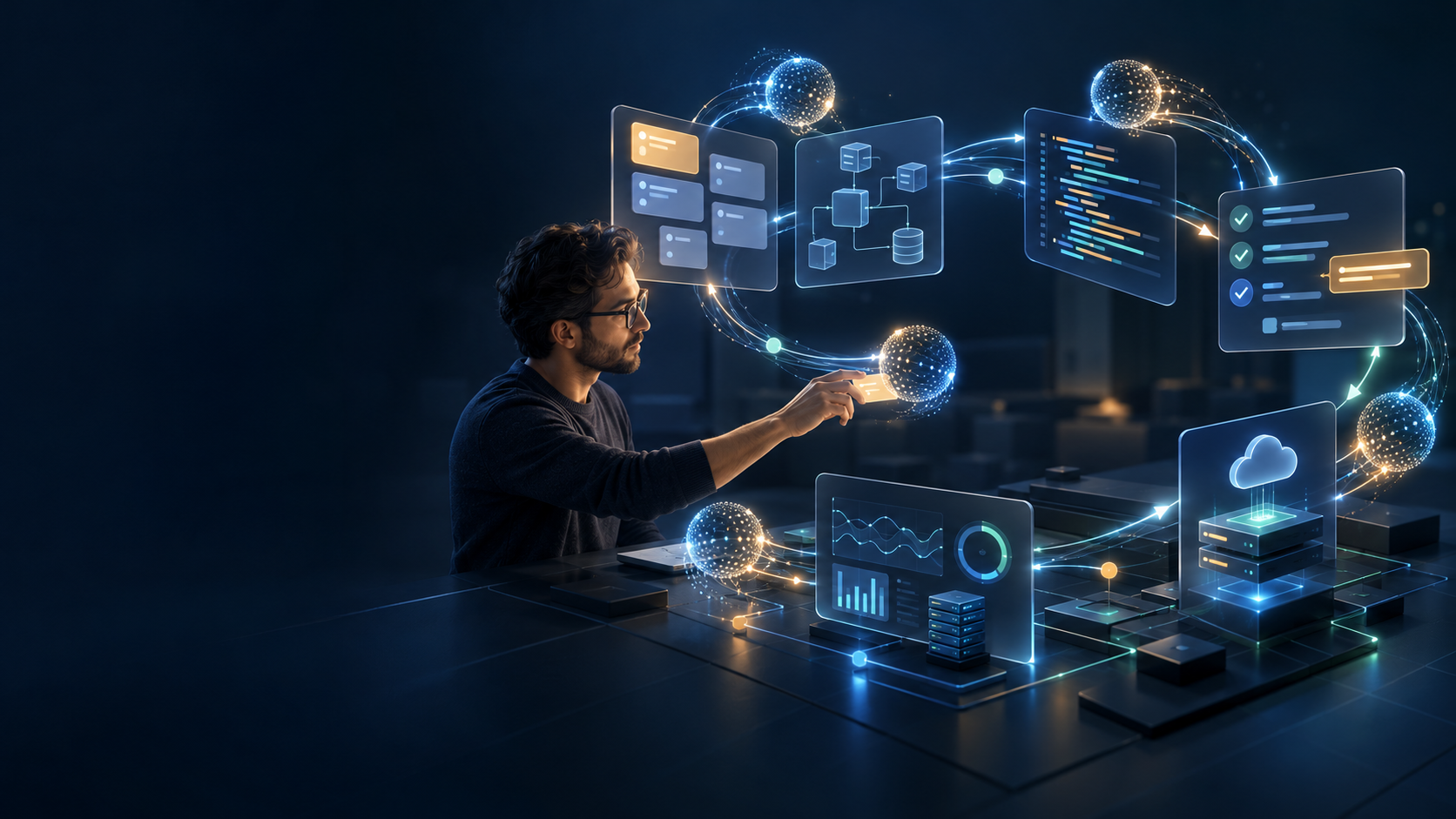
The SDLC is no longer only a linear pipeline of human hand-offs. It becomes a system in which people make important decisions, agents move work forward and each cycle improves the context available to the next one.
An AI agent may be technically capable, but it can still produce confident and incorrect results if it does not understand the product’s purpose, previous architectural decisions, engineering standards, customer expectations and dependencies between systems.
For this reason, the foundation of an AI-native SDLC is not just a powerful model. It is reliable, governed organisational context.
Atlassian’s Teamwork Graph is designed to connect work in Jira, knowledge in Confluence, source code, Loom recordings and information from connected systems. Code Context extends this approach into the codebase, allowing agents to understand files, classes, functions, symbols and relationships across repositories.
This means an agent can move beyond answering, “How should I change this code?” It can develop a better understanding of why the change is needed, which systems it may affect and how it relates to the intended business outcome.
The goal of an AI-native SDLC is not to remove people from software development. It is to use human attention where it creates the most value.
People remain responsible for:
Agents may perform more of the work, but accountability remains with people and with the operating system created by the organisation.
An AI-native transformation should not begin by changing the entire development lifecycle at once. A better starting point is one limited and measurable bottleneck.
Possible examples include:
A team can then run a focused pilot with clear success measures. The goal should not simply be to generate more code. It should be to reduce cycle time and rework, protect quality and improve the developer experience.
The amount of code generated or the frequency of AI tool usage does not, on its own, demonstrate a successful transformation. Four dimensions should be assessed together:
Without these measures, faster code generation can create additional work during review, testing and maintenance. Establish a baseline before the pilot, then compare results using the same indicators.
An AI-native SDLC is not achieved by distributing a coding assistant to every developer. It requires rethinking the entire software development system—from planning to operations—so that people, AI agents, organisational knowledge and governance work together.
Three elements must be designed as one system:
At Ponsatlas, we combine our Atlassian expertise with AI and operating-model design. Our aim is not merely to introduce new AI tools, but to help organisations build software development systems in which those tools create measurable, secure and sustainable value.
Contact us to assess your team’s readiness for AI-native software development and identify a practical first pilot.